Quick answer: enroll, test and plan recovery before enforcing passkeys
Plan a Microsoft 365 passkey rollout with a practical checklist for account scope, device compatibility, recovery, pilot testing and phishing-resistant MFA.
Make stronger authentication usable in everyday work
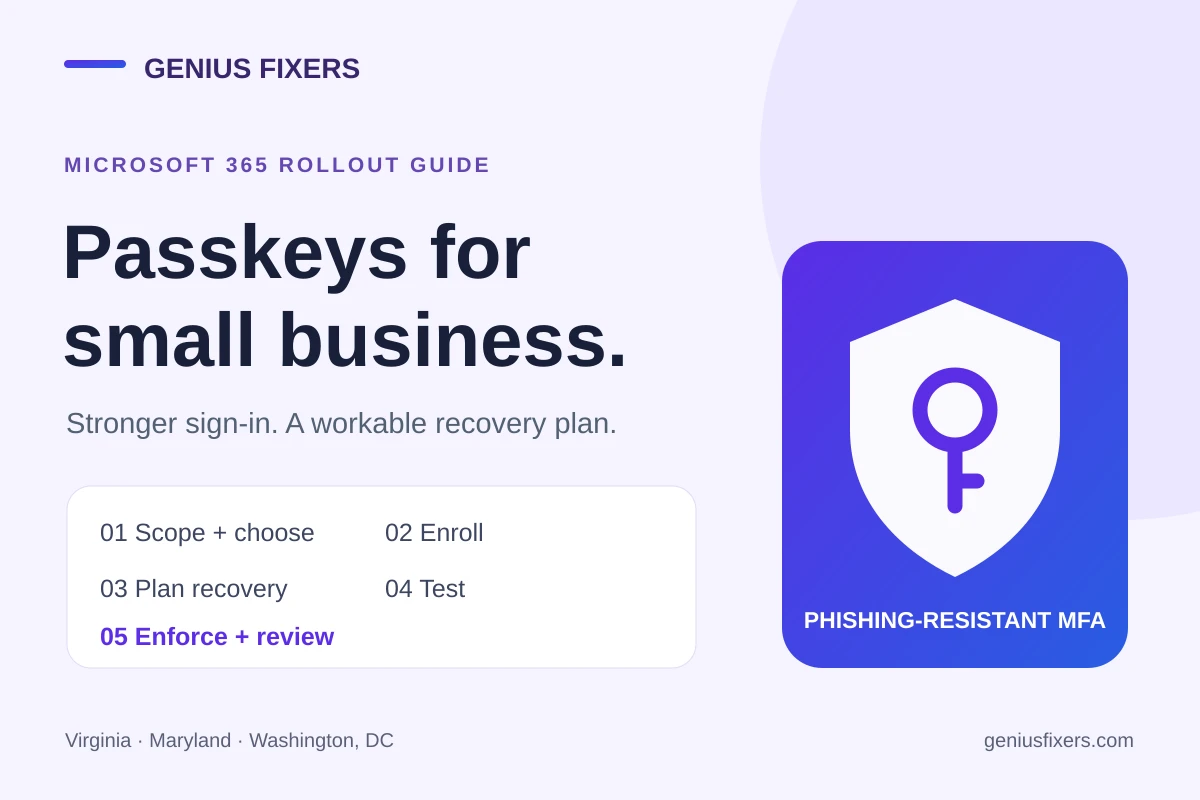
A small-business passkey rollout should begin with privileged and high-impact accounts, confirm supported devices and applications, establish a secure recovery process and test a limited group before wider enforcement. The checklist below helps a business owner and IT provider agree on those steps without treating registration alone as completion.
What makes a passkey different from a text-message code?
Multifactor authentication is an important step beyond a password, but the method matters. A criminal can ask someone to type an SMS or authenticator code into a convincing fake sign-in page. Repeated push requests can also pressure an employee into approving a login they did not start.
A passkey uses a cryptographic key pair tied to the service where it was registered. The user unlocks the credential with a device PIN or biometric check, rather than handing a reusable secret to the website. That binding is what gives FIDO2 passkeys their phishing resistance. Microsoft explains the mechanism in its passkey overview.
Be specific when asking your provider about Microsoft Authenticator. A passkey stored in the app is different from approving a push notification or entering a rotating code. Installing the app alone does not establish which method an employee actually uses. CISA recommends moving toward phishing-resistant MFA and identifies number matching as an improvement when stronger methods cannot yet be deployed.
1. Start with the accounts that could do the most damage
Begin with an account inventory, not a bulk purchase of security keys. Identify who can reset passwords, manage Microsoft 365, approve payments, access client files or administer backup systems. Include outside IT providers and temporary accounts. Give each account a business owner and a documented purpose.
For a small office, a sensible pilot includes an administrator, someone in finance and a staff member who regularly works away from the office. This tests privileged access, a sensitive everyday workflow and a different device setup. Keep administrative accounts separate from ordinary email and browsing accounts.
- Record the applications each pilot user must reach, including older desktop tools and mobile apps.
- List the operating systems, browsers, shared workstations and remote-access arrangements involved.
- Identify staff who need a company-provided option instead of using a personal phone.
- Record who can authorize enrollment and who handles a lost device.
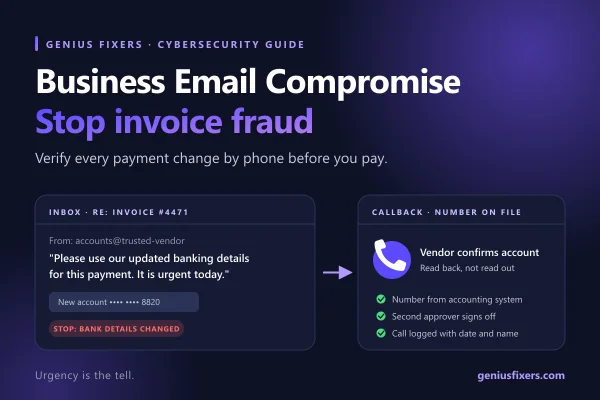
For payment workflows, pair stronger sign-in with an independent callback process for changed bank details. Our business email compromise guide explains why protecting a mailbox and verifying a payment instruction are separate responsibilities.
2. Choose a method people can use in their actual work
Do not assume one credential fits every role. A physical FIDO2 security key can suit a privileged account or a worker who needs a company-controlled authenticator. Windows Hello for Business may fit staff working on managed Windows devices. Supported passkeys on other devices can fit different working patterns. Your administrator should check what the tenant permits and what each application supports.
Microsoft's FIDO2 compatibility matrix distinguishes operating systems, browsers and application scenarios. Test the combinations your staff use before buying hardware or removing an existing sign-in option. A successful browser login does not prove that an older desktop application or a remote desktop workflow will work the same way.
For a shared workstation, give people individual accounts and individual authentication methods. Avoid leaving a shared security key permanently connected and passing its PIN around. Decide how staff will sign out, how a replacement worker will sign in and where spare equipment will be stored.
3. Check licenses and policy settings before enforcing anything
In Microsoft Entra, allowing people to register a method and requiring them to use it are different controls. The authentication methods policy governs available methods. Conditional Access authentication strengths can require an acceptable method for a specified resource. Microsoft's authentication strengths documentation explains those controls and their limitations.
Ask your administrator to confirm license requirements for the proposed policy and affected users. Microsoft's licensing guide lists Entra ID P1 as included in Microsoft 365 Business Premium. Do not infer that a similarly named Microsoft 365 plan includes the same identity features.
Write down the intended scope: which users, which applications, which acceptable methods and which documented exceptions. Have an administrator review the interaction with existing security settings. Replacing a broad protection with an incomplete pilot policy could leave other staff exposed.
4. Prepare recovery before the first lost phone
A rollout is unfinished if the only recovery instruction is “call IT.” Agree on how the help desk will verify a person's identity without trusting the same potentially compromised account. Define who approves a reset, where the event is recorded and how access is restored outside normal office hours.
Microsoft supports Temporary Access Pass, a time-limited credential that can help an authorized user register a new authentication method. Treat it as a controlled recovery tool. Limit its lifetime and use, deliver it through an approved process and remove obsolete authentication methods when a device is replaced.
Tenant-level recovery needs its own plan. Microsoft recommends two or more emergency access accounts, protected and monitored for emergency use. Have your administrator follow the current guidance, verify policy exclusions needed to prevent lockout and test access. An ordinary employee's spare key is not a substitute for this administrative recovery path.
5. Test the policy, then expand in small groups
Enroll the pilot users before enforcing a method they do not yet have. Microsoft warns that enforcing phishing-resistant MFA before administrators register suitable methods can lock them out. Its administrator policy guidance starts with report-only evaluation before enforcement.
Report-only mode helps an administrator review how a Conditional Access policy would evaluate sign-ins. It does not enforce the new requirement. Review those results, resolve conflicts and then enforce the policy for the pilot group during a staffed support window.
- Normal work: Sign in to email, Teams, file storage and each critical business application.
- Different context: Test the approved mobile, off-site and shared-device scenarios.
- Recovery: Walk through a simulated lost authenticator using the written identity-check process.
- Unacceptable method: Confirm a weaker sign-in method cannot complete access where the stronger requirement applies.
- Administration: Verify the approved emergency access path remains usable and monitored.
Track results by person and application. A registration count alone is a poor completion measure: the stronger method must be usable, required where intended and recoverable. Assign an owner and review date to every exception before expanding to another group.
A practical rollout record for a small office
The following is a planning example, not a claim about a completed client deployment. Keep one record per group so a manager can see what is ready without reading sign-in logs.
- Scope: Name the users, applications and business owner.
- Ready: Confirm the chosen authenticators are enrolled and normal work has been tested.
- Recoverable: Record the recovery test date and authorized help desk contact.
- Enforced: Record who reviewed the policy, when it was enabled and how successful use was checked.
- Open issues: List application exceptions, temporary controls, responsible owners and review dates.
After rollout, include credential ownership in employee onboarding and offboarding. Review lost-device reports, changes to registered authentication methods and policy exceptions. Keep endpoint protection, patching and least-privilege access in place: a passkey does not stop malware on an already compromised device or make every request in a legitimate account trustworthy.
Frequently asked questions
Should we turn off our existing MFA while preparing passkeys?
No. Keep existing protection in place while an administrator designs and tests the transition. Change fallback methods only after enrollment, application compatibility, recovery and policy coverage have been verified.
Does every employee need a physical security key?
No. The right choice depends on supported devices, tenant policy and the person's work. Some roles may use an approved device-based method; others may need a company-provided FIDO2 key. Test before buying for everyone.
Does registering a passkey mean Microsoft 365 always requires it?
No. Registration makes a method available. The effective access policies determine what a user must present for a particular resource. Ask your administrator to verify both settings and real sign-in behavior.
Can passkeys prevent every account compromise?
No. They improve resistance to credential phishing. Device compromise, stolen sessions, unsafe recovery and excessive permissions still need attention. Treat stronger authentication as one part of an ongoing security program.
Plan a rollout your team can support
Genius Fixers helps businesses in Virginia, Maryland and Washington, DC plan multifactor authentication management alongside managed IT and cybersecurity support. Start with the people, devices and applications you need to protect, then agree on scope, recovery responsibilities and support coverage.
Book a free IT discovery call or call 703-419-9000 to discuss a Microsoft 365 authentication review. Bring your current license list, device inventory and critical application list; do not send passwords or recovery codes.
Published October 14, 2026. Product capabilities and licensing can change; confirm current Microsoft documentation and your tenant configuration before implementation.