Unstable office Wi-Fi is not always a signal problem
Intermittent wireless service can begin with coverage, capacity, interference, a client device, cabling, switching, address assignment or the upstream internet path. Define who is affected, where and when before replacing equipment.
Test the complete connection path
Compare another device in the same area, the same device in another area and a wired connection. Record the time, location, network name and affected application, then review the access point, cable, switch port, gateway, DNS and internet path. Validate any change with the real business workflow instead of relying only on a dashboard.
When office Wi-Fi keeps dropping, the most visible symptom is not always the actual cause. A laptop may show strong signal while video calls freeze. One conference room may struggle every afternoon, while wired computers remain stable. Staff may call every slowdown a Wi-Fi problem even when the interruption begins with an internet circuit, switch, cable, address assignment or cloud application.
The fastest way to a durable fix is to narrow the problem before changing equipment. Identify who is affected, where it happens, when it happens and which part of the connection stops working. Then test the wireless network together with the wired infrastructure and services behind it.
Start by defining what “dropping” means
Different symptoms point toward different parts of the network. Ask the affected person what they can still do during the interruption. Can they reach an internal printer? Does only a video meeting fail? Does the Wi-Fi icon disappear, or does it stay connected with no internet access?
| What people notice | Useful first checks | Possible area to investigate |
|---|---|---|
| Only one device disconnects | Compare another device in the same seat and review the affected device's adapter, driver and power settings | Client device or authentication |
| Everyone in one room has trouble | Identify the serving access point and test its uplink, power and local radio conditions | Coverage, interference, access point, cable or switch port |
| The whole office loses internet | Test a wired connection and review firewall, switch and internet-provider status | Internet circuit or shared network infrastructure |
| Signal looks strong but applications stall | Test latency, packet loss, DNS and the affected application from wired and wireless devices | Capacity, upstream network or application path |
| Calls break up while someone walks | Record the route and review which access points the device uses | Roaming, coverage overlap or client behavior |
This first pass prevents a common mistake: replacing access points when the failing component is outside the wireless layer.
Seven common causes of unstable business Wi-Fi
1. Coverage does not match the working space
Walls, doors, storage, building materials and the distance between a device and an access point can change the usable signal. A floor plan is a starting point, not proof of performance. Coverage should be checked where people actually work, including conference rooms, reception areas, warehouses and temporary work zones.
An access point hidden above dense material or installed at one end of a long suite may not serve the areas that matter. The solution may involve placement, cabling and radio design—not simply turning transmit power to its highest setting.
2. The network has coverage but not enough capacity
A device can display a strong Wi-Fi signal while sharing airtime with many other devices. Video meetings, cloud file synchronization, guest traffic, phones, printers and connected equipment all compete for the wireless network and the internet connection behind it.
Capacity problems often appear at predictable times or in busy rooms. Record the device count and activity when the issue occurs. A quiet after-hours test may miss the condition entirely.
3. Radio interference or a poor channel plan
Neighboring networks, personal hotspots and other radio sources can affect the wireless environment. Access points from the same business can also compete when placement, channel selection and power are not coordinated.
A scan can show nearby networks, but a useful investigation also connects that information with real user experience. The goal is not to find an empty channel at one moment; it is to create a stable design for the times and places that matter to the business.
4. A bad cable, switch port or power source
Most business access points rely on a wired uplink and often receive power from the network switch. A damaged cable, unstable Power over Ethernet supply, misconfigured switch port or overloaded uplink can make a wireless problem appear and disappear.
Check the complete path: access point, cable, patch panel, switch port, VLAN configuration, firewall and internet service. This is why structured network infrastructure and wireless design should be considered together.
5. Roaming behavior between access points
In an office with multiple access points, a phone or laptop decides when to leave one connection and join another. Poor coverage overlap, inconsistent settings or client behavior can leave a device attached to a less useful access point as the user moves.
Reproduce the problem with the same device, application and walking route. Note the point where quality changes. A test from a stationary desk will not expose a handoff problem during a voice or video call.
6. Addressing, name resolution or authentication failures
Joining the Wi-Fi network is only one step. The device may still need an IP address, a working gateway, name resolution and successful authentication. If those services respond slowly or fail, users may see “connected, no internet” even when radio coverage is adequate.
Logs and timestamps are valuable here. Record the device name, user, network name and approximate time so the support team can compare the complaint with DHCP, DNS, identity, firewall and access-point events.
7. Inconsistent configuration or unmanaged change
Firmware, security settings, network names and access policies should be managed as a system. A replacement access point installed with different settings, an undocumented switch change or an old guest network can create intermittent behavior and unnecessary risk.
The National Institute of Standards and Technology notes that wireless security depends on client devices, access points and wireless switches throughout the WLAN lifecycle, from design and deployment through maintenance and monitoring. Its Guidelines for Securing Wireless Local Area Networks are security-focused, but the lifecycle view is useful operationally too: stable Wi-Fi needs documented configuration and ongoing oversight, not only a one-time installation.
A practical office Wi-Fi troubleshooting sequence
- Capture the symptom before rebooting. Record the time, location, device, user, application and network name. Take a screenshot of the exact error when possible.
- Determine the scope. Check another device in the same area, the same device in another area and a wired connection. This separates a client issue, a local wireless issue and a wider outage.
- Confirm the connection path. Review the serving access point, its cable, switch port, power, VLAN, gateway, DNS and internet path.
- Review logs around the reported time. Look for access-point restarts, authentication failures, address-assignment problems, switch events and firewall or circuit interruptions.
- Measure during normal business use. Repeat representative activities when the office is busy. Include video, voice, cloud applications and any line-of-business devices that depend on Wi-Fi.
- Survey the affected space. Check coverage, interference and roaming along the routes people actually use. Include newly added walls, furniture, equipment and neighboring networks.
- Change one controlled variable at a time. Document the baseline, the change and the result. Multiple simultaneous changes may hide the true cause and make rollback harder.
- Validate with the affected users. A dashboard improvement is helpful, but the test is incomplete until the real workflow operates reliably.
Ongoing network monitoring and management can provide context for recurring problems, especially when staff reports arrive after the interruption has ended.
Planning new access points as part of a renovation? Read which cable to pull for new Wi-Fi 7 access points before the ceiling closes.
Should you add another access point?
Another access point may be appropriate when a survey identifies a coverage or capacity gap and the supporting cable, power and network design can accommodate it. It is not a universal fix.
Adding equipment without coordinated placement and configuration can create more competition, confusing roaming behavior or an unmanaged security boundary. Consumer range extenders are especially difficult to support in a business that needs predictable handoffs, guest access, segmentation and centralized administration.
A planned wireless access point installation should connect the floor plan, expected devices, cable routes, switch capacity, internet service and post-installation testing.
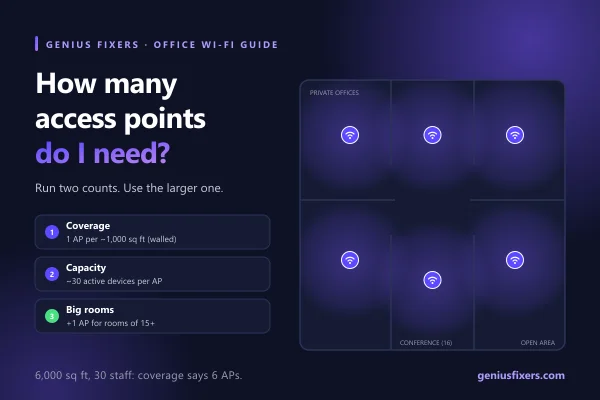
Before adding hardware, work out how many wireless access points your office needs with a coverage count and a capacity count.
Keep guest and business traffic deliberately separated
Guest access, employee devices and connected equipment do not all need the same access. Segmentation can limit which systems each group can reach and make troubleshooting easier, but only when the firewall, switching and wireless configuration agree.
Document each network's purpose, authorized users, access rules and owner. Remove old network names when they are no longer needed, review administrative access and keep firmware and configuration backups under change control. These practices belong in the wider business cybersecurity plan; no single wireless setting guarantees security.
When an on-site assessment makes sense
Remote support can review controller status, configuration, logs and the upstream network. An on-site assessment is useful when the issue depends on the building, radio environment, cabling or movement through the space.
Prepare a marked floor plan, current equipment list, approximate device counts, problem times and examples of affected applications. Include planned construction, team growth and any areas that will soon need service. This turns a vague complaint into a scope that can be measured and tested.
Get help with unreliable office Wi-Fi
Genius Fixers helps businesses assess Wi-Fi coverage, access-point placement, cabling, switching, network configuration and recurring connectivity problems as one connected system. Based in Manassas, Virginia, Genius Fixers provides remote support and scheduled on-site service for businesses in Virginia, Maryland and Washington, DC.
Book a free phone or Zoom consultation to discuss the areas, devices and business workflows affected by unstable Wi-Fi.
Call 703-419-9000 or email info@geniusfixers.com.
Frequently asked questions
Why does my laptop show full Wi-Fi bars but have no internet?
The bars usually describe the radio connection to an access point, not the health of DNS, the gateway, firewall, internet circuit or application. Compare the same task on a wired device and check whether other wireless users are affected.
Will rebooting the access point fix office Wi-Fi?
A reboot may restore service temporarily, but it can also erase the most useful evidence. Capture the time and symptoms first, review logs when available and investigate why the interruption occurred if the problem returns.
Does adding more access points always improve coverage?
No. Placement, channel use, power, cabling, client behavior and capacity all matter. Add an access point when a survey and requirements review show where it is needed and how it will be integrated.
Should guests use the same Wi-Fi as employees?
Usually, guest access should be intentionally separated from business systems and managed with an appropriate firewall and network policy. The exact design depends on the devices, applications and access requirements in the office.
Can Genius Fixers troubleshoot office Wi-Fi on site?
Yes. Genius Fixers offers remote support and scheduled on-site service for business networks across Virginia, Maryland and Washington, DC. The first step is to document the affected locations, devices, timing and applications so the right assessment can be scoped.